


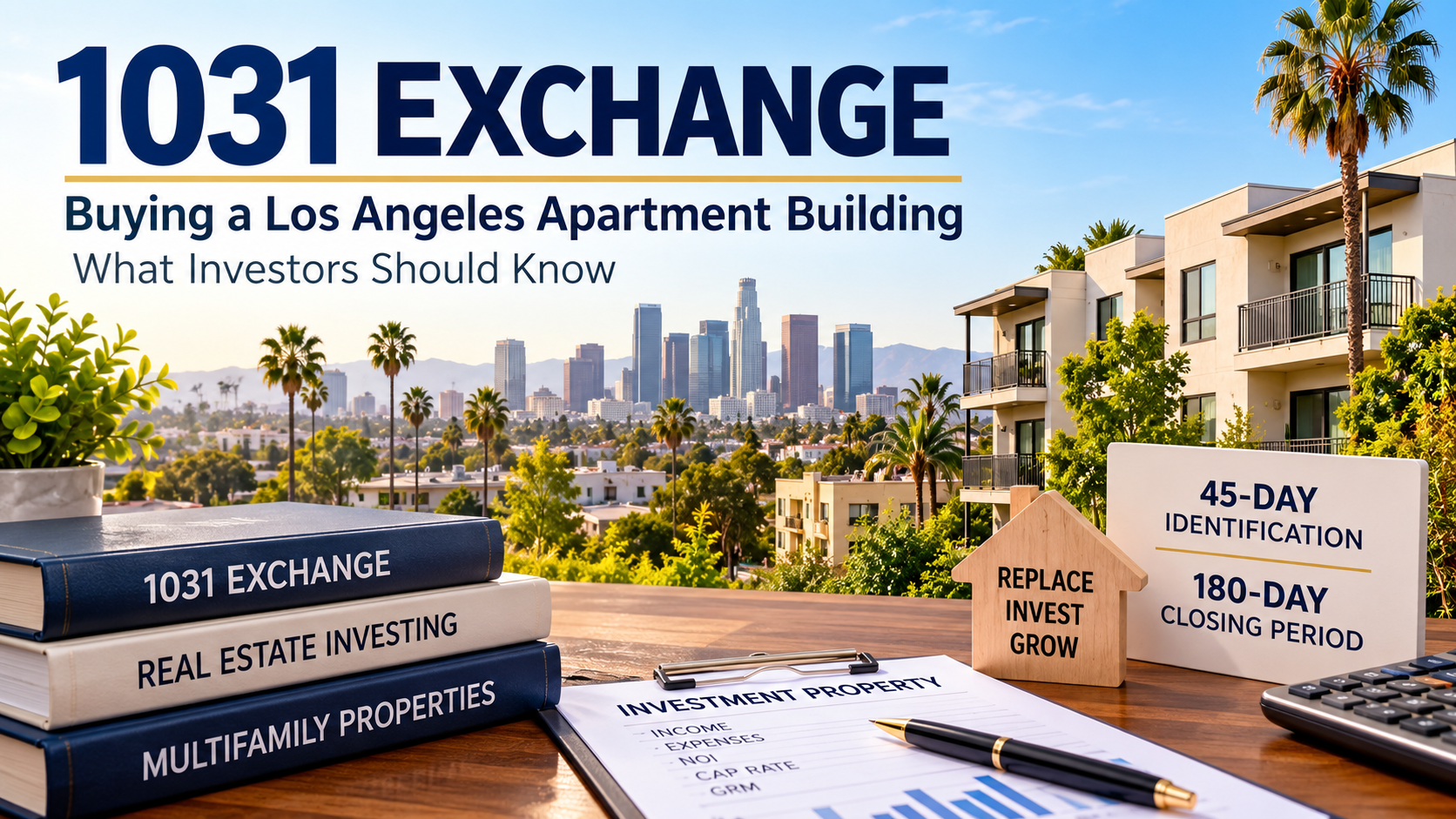
 Buying an apartment building in Los Angeles as part of a 1031 exchange can be an attractive strategy for real estate investors who want to continue investing in income-producing property while potentially deferring recognition of certain taxable gains.
But a 1031 exchange is not simply a matter of selling one property and buying another. There are important requirements, strict deadlines and investment considerations that should be understood before choosing a replacement property.
As a Los Angeles real estate professional with more than 20 years of experience, including extensive experience with multifamily and income-producing properties, I help investors identify and evaluate apartment-building opportunities based on both the property and its investment fundamentals.
What Is a 1031 Exchange?
Section 1031 of the Internal Revenue Code allows qualifying investors to exchange real property held for investment or business purposes for other qualifying real property and potentially defer recognition of gain.
For real estate investors, this may provide an opportunity to move from one investment property into another while keeping more capital invested in real estate.
A 1031 exchange does not eliminate taxes automatically, and every investor's circumstances are different. Investors should work with qualified tax and exchange professionals to determine whether a transaction qualifies.
Can an Apartment Building Be a 1031 Exchange Replacement Property?
An apartment building held for investment can potentially qualify as replacement property in a 1031 exchange.
One important concept is that “like-kind” does not necessarily mean exchanging an identical type of building for another identical building. Qualifying U.S. investment real estate can generally be exchanged for other qualifying U.S. investment real estate, subject to the applicable rules.
For example, an investor selling qualifying investment real estate may potentially acquire a Los Angeles apartment building as the replacement property.
Understand the 45-Day Identification Period
Timing is one of the most important parts of a deferred 1031 exchange.
Generally, an investor must identify potential replacement property within 45 days after transferring the relinquished property.
That can make the search for a replacement apartment building very different from an ordinary real estate purchase. Investors may need to evaluate available properties quickly while still performing careful financial analysis.
Starting the property search early can therefore be extremely important.
Understand the 180-Day Exchange Period
Generally, the replacement property must be received within 180 days after transferring the relinquished property, or by the due date of the investor's tax return, including extensions, whichever occurs first.
Because the deadlines can be strict, investors should coordinate early with their qualified intermediary, tax professional, lender and real estate professional.
The Role of a Qualified Intermediary
In a typical deferred 1031 exchange, investors often use a qualified intermediary to facilitate the exchange.
One critical issue is avoiding actual or constructive receipt of the proceeds from the relinquished property. A properly structured exchange using a qualified intermediary can help facilitate the transaction while the investor acquires the replacement property.
The qualified intermediary should generally be selected and the exchange structure discussed before the relinquished property closes.
Don't Let the 1031 Deadline Replace Good Investment Analysis
The pressure of a 1031 exchange deadline can make investors feel they must purchase something quickly.
But meeting an exchange deadline does not automatically make a property a good investment.
When evaluating a Los Angeles apartment building, investors should still examine important factors such as:
- Current rental income
- Operating expenses
- Net Operating Income (NOI)
- Cap rate
- Gross Rent Multiplier (GRM)
- Unit mix
- Current and potential rents
- Property condition
- Location
- Comparable sales
- Financing
- Potential capital improvements
- Overall investment objectives
A replacement property should make sense as an investment—not simply satisfy a deadline.
Evaluate the Apartment Building's NOI
Net Operating Income is one of the most important numbers when evaluating an apartment building.
NOI = Property Income − Operating Expenses
Review the property's actual income and operating expenses rather than relying only on projected numbers.
Understanding the NOI can help investors compare different multifamily opportunities and evaluate the property's income-producing performance.
Consider Cap Rate and GRM
Cap rate and Gross Rent Multiplier are two commonly used tools for evaluating multifamily properties.
Cap Rate = NOI ÷ Property Value
Cap rate can help investors compare a property's income to its price.
GRM compares a property's price with its gross rental income. It is a simpler metric and does not account for operating expenses, so it should generally be considered alongside NOI, cap rate and other financial information.
Perform Careful Due Diligence
The 1031 exchange timeline should not eliminate proper due diligence.
Depending on the property and transaction, an investor may want to review items such as leases, rent rolls, operating statements, expenses, building condition, inspections, insurance, financing, title matters and other relevant property information.
The goal is not simply to complete an exchange. The goal is to acquire an investment property that fits the investor's objectives.
Start Looking for Replacement Properties Early
Investors who know they may be completing a 1031 exchange should consider discussing their property criteria before the relinquished property closes.
Knowing your preferred location, price range, number of units, desired return, financing strategy and investment goals can make the replacement-property search more focused once the exchange timeline begins.
Looking for a Los Angeles Apartment Building for a 1031 Exchange?
If you're considering purchasing a Los Angeles apartment building or multifamily property as part of a 1031 exchange, I can help you identify available opportunities and evaluate properties based on factors such as rental income, expenses, NOI, cap rate, GRM, location, comparable sales and investment potential.
Important: This information is provided for general educational purposes only and is not tax, legal or financial advice. Section 1031 transactions can involve complex requirements and individual circumstances. Investors should consult a qualified tax professional, attorney and qualified intermediary regarding their specific exchange.