San Fernando Valley & Los Angeles Real Estate Insights

Welcome to the real estate blog of Shawn Pourebrahim, a Keller Williams real estate professional with over 20 years of experience serving Los Angeles and the San Fernando Valley.

Explore helpful real estate articles, local housing market updates, and expert guidance for homeowners, buyers, sellers, and investors in Tarzana, Encino, Woodland Hills, Sherman Oaks, and surrounding communities.

Whether you're wondering what your home is worth, considering selling your property, buying your first home, or evaluating a multifamily apartment building investment, you'll find practical information to help you make informed decisions.

Stay informed about local market trends, home values, selling strategies, and Los Angeles income-property opportunities. When you're ready for personalized guidance, I'm here to help.

Nov. 5, 2026

Buying a Home in Reseda: What to Know Before Making an Offer

Aerial view of Reseda homes, Reseda Park Lake, and Reseda Boulevard crossing the Los Angeles River
Reseda neighborhood, park, and Los Angeles River, photographed in September 2019 by Eric Shalov. CC BY-SA 4.0, via Wikimedia Commons.

Buying a home in Reseda involves more than finding a listing with the right bedroom count. Before making an offer, compare the home's condition, total ownership costs, property records, and location against your daily needs and long-term plans.

I'm Shawn Pourebrahim, a Los Angeles and San Fernando Valley real estate professional with more than 20 years of experience. I help buyers organize their search, evaluate comparable properties, prepare offers, and navigate the questions that arise during inspections and escrow.

View More
Nov. 5, 2026

Selling Your Reseda Home: Pricing, Preparation, and What Buyers Notice

Trees and open lawn at Reseda Park in Los Angeles
Reseda Park, photographed in November 2025 by Alexis Doine. CC0 public domain, via Wikimedia Commons.

Selling your Reseda home starts with three decisions: how to price it, what to prepare before listing, and how to present the features buyers will compare. A detached house, condo, or townhome needs a strategy based on its own condition, ownership costs, and competing properties.

I'm Shawn Pourebrahim, a Los Angeles and San Fernando Valley real estate professional with more than 20 years of experience. I help homeowners evaluate their options, prioritize preparation, and navigate pricing, marketing, offers, and the steps toward closing.

View More
Nov. 5, 2026

Buying a Home in Canoga Park: Condos, Townhomes, and Houses Compared

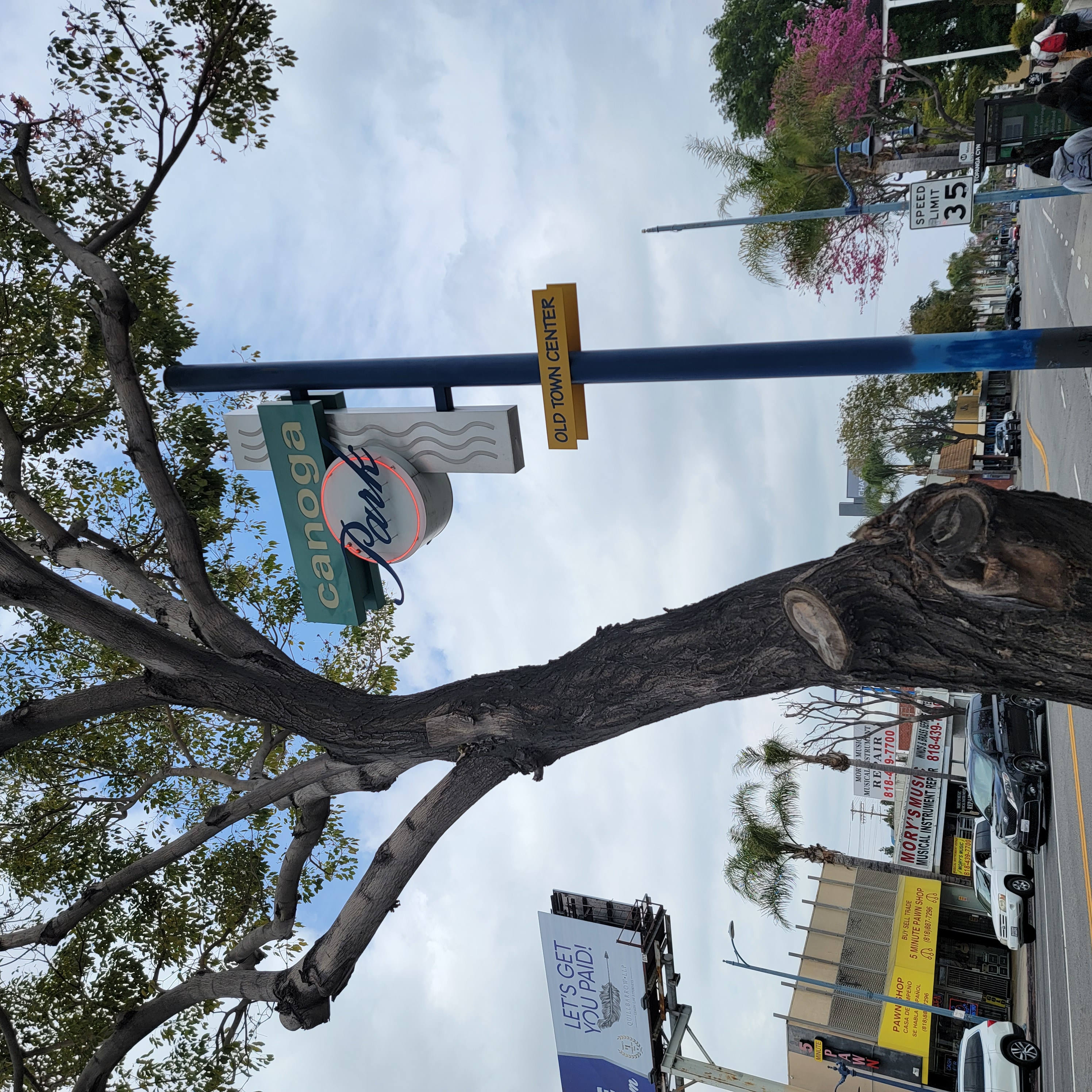
Canoga Park Old Town Center sign beside Sherman Way
Canoga Park's Old Town Center sign on Sherman Way. Photo by David James Henry, CC BY-SA 4.0, via Wikimedia Commons. Display cropped to fit.

Buying a home in Canoga Park starts with choosing the type of property that fits your budget, daily routine, and willingness to handle maintenance. A condo, townhome, and detached house can offer very different ownership experiences, even when their asking prices are similar.

I'm Shawn Pourebrahim, a Los Angeles and San Fernando Valley real estate professional with more than 20 years of experience. I help buyers compare properties, review the questions behind the listing, and prepare a purchase strategy around their own goals.

View More
Nov. 1, 2026

How Much Is My Canoga Park Home Worth in 2026? A Local Seller's Guide

Wondering how much your Canoga Park home could sell for in today's market? If you own a house, condominium, or townhome in Canoga Park, the answer depends on more than a neighborhood average or an automated online estimate.

Canoga Park offers a mix of established single-family neighborhoods, condominiums, townhomes, and smaller residential properties. The most useful starting point is a valuation based on your home's individual features and recent comparable sales.

View More
Oct. 8, 2026

How Much Is My Sherman Oaks Home Worth in 2026? A Homeowner's Guide

Sherman Oaks Home Values 2026 – Homeowner's Guide to Property Values and Selling

How Much Is My Sherman Oaks Home Worth in 2026?

Curious what your Sherman Oaks home is worth?

Request Your Complimentary Home Valuation - No obligation.

If you own a home in Sherman Oaks, California, you may be wondering how much your property could sell for in today's real estate market. Whether you're considering selling soon, relocating, downsizing, or simply exploring your options, understanding your home's value is an important first step.

Sherman Oaks offers a wide variety of residential properties, from traditional single-family homes and condominiums to remodeled luxury residences and hillside properties. Because homes can differ significantly in location, condition, lot size, and amenities, two properties in the same neighborhood may have very different market values.

Here are several important factors to consider when evaluating your Sherman Oaks home in 2026.

1. Location Within Sherman Oaks Matters

Sherman Oaks is not a one-size-fits-all housing market. Homes located south of Ventura Boulevard, near the hills, or along quieter residential streets may appeal to different buyers than homes closer to major roads and commercial corridors.

School boundaries, proximity to shopping and dining, freeway access, lot characteristics, and neighborhood surroundings can also influence buyer interest.

When determining a home's potential selling price, it's important to compare it with properties in the most relevant nearby area rather than relying solely on a citywide average.

2. Recent Comparable Sales Help Establish Market Value

One of the most useful tools for estimating a home's value is a comparative market analysis, often called a CMA.

A CMA reviews recently sold homes with characteristics similar to yours, including:

  • Square footage and lot size

  • Number of bedrooms and bathrooms

  • Property condition and renovations

  • Garage and parking accommodations

  • Location and surrounding neighborhood

  • Recent sale prices and competing listings

Active listings show what sellers are asking, but closed sales provide evidence of what buyers have actually paid.

A well-prepared CMA considers both types of information, along with current competition and market conditions.

3. Renovations and Property Condition Can Influence Value

Updated kitchens, remodeled bathrooms, modern flooring, attractive landscaping, and well-maintained systems may help a Sherman Oaks property appeal to buyers.

However, not every renovation produces an equal return on investment.

Before spending money on major improvements, homeowners should consider whether the expected increase in selling price is likely to justify the expense.

In some situations, minor cosmetic improvements, professional cleaning, landscaping, and thoughtful staging can make a meaningful difference without requiring a complete remodel.

4. Lot Size, Floor Plan, and Property Features Matter

Buyers often consider more than interior square footage.

Depending on the property, desirable features may include:

  • Functional floor plans and spacious living areas

  • Private backyards and outdoor entertaining spaces

  • Swimming pools or usable hillside views

  • Additional living space or permitted accessory dwelling units

  • Updated kitchens and bathrooms

  • Convenient parking and garage space

The value of these features depends on buyer demand, condition, permitted status, and comparable sales.

For example, an accessory dwelling unit may be attractive to certain buyers, but its contribution to value should be evaluated carefully rather than assumed.

5. Online Home Estimates Are Only a Starting Point

Many homeowners begin by checking an automated estimate on a real estate website.

These tools can be convenient, but they may not fully account for a home's interior condition, remodeling quality, views, layout, or other unique characteristics.

An automated estimate also may not reflect differences between individual streets or smaller sections of Sherman Oaks.

For homeowners seriously considering selling, a personalized property evaluation can provide a more informed starting point.

6. Should You Sell Your Sherman Oaks Home in 2026?

The right time to sell depends on your circumstances, financial goals, and local market conditions.

Some homeowners may want to sell because they are relocating, retiring, downsizing, or moving into a different property. Others may be considering selling an investment property or using their equity for another opportunity.

Before deciding, consider:

  • Your estimated property value

  • Your remaining mortgage balance

  • Potential selling expenses

  • Current competition from similar homes

  • Your preferred moving timeline

  • Your financial and personal goals

Rather than relying on predictions about future prices or interest rates, it's often more productive to understand your options based on today's available information.

7. How Can You Determine What Your Sherman Oaks Home Could Sell For?

The most reliable starting point is a property-specific evaluation that considers recent comparable sales, competing listings, property condition, and current buyer demand.

An effective pricing strategy should aim to attract qualified buyers while supporting your financial objectives.

Pricing too high can discourage interest and lead to longer marketing times. Pricing too low without a clear strategy can also create unnecessary risk.

Every property deserves an individual assessment.

Request a Complimentary Sherman Oaks Home Valuation

Are you curious about what your Sherman Oaks home could sell for?

Whether you're planning to sell soon or simply exploring your options, I can help you review your property's potential market value and discuss possible next steps.

I'm Shawn Pourebrahim, a real estate professional with more than 20 years of experience with Keller Williams. My experience includes residential real estate transactions in Sherman Oaks and throughout the San Fernando Valley, as well as income-producing properties across Los Angeles.

Request your complimentary home valuation to get started.

There is no obligation, and you can explore your selling options at your own pace. For more information about my selling process, explore my home selling services.

Shawn Pourebrahim | Keller Williams Luxury | Serving Sherman Oaks, Tarzana, Encino, Woodland Hills, and the Greater Los Angeles Area

Oct. 7, 2026

Buying Investment Property in Los Angeles: A Guide for New & Experienced Investors

Real estate investing in Los Angeles guide for rental properties, multifamily investments, NOI, cap rates, GRM and 1031 exchangesReal estate investing in Los Angeles can offer opportunities to build long-term wealth, generate rental income and diversify an investment portfolio. But successful real estate investing requires more than simply buying a property and hoping its value increases.

With more than 20 years of experience in Los Angeles real estate, including extensive experience with apartment buildings, multifamily and income-producing properties, I help investors evaluate properties based on both current market conditions and the property's financial fundamentals.

Whether you're considering your first Los Angeles apartment building, purchasing an apartment building, expanding an existing portfolio or completing a 1031 exchange, understanding the numbers behind the investment is an important place to start.

Already own an apartment building in Los Angeles? Find out what your investment property may be worth. Request a confidential apartment building valuation.

Looking for Investment Property in Los Angeles?

Whether you're purchasing your first rental property, expanding your investment portfolio, or searching for an apartment building, get personalized guidance from an experienced Los Angeles real estate professional.

REQUEST YOUR FREE INVESTOR CONSULTATION

Looking to Buy an Investment Property in Los Angeles?

Whether you're searching for your first rental property, a duplex, a multifamily apartment building, or your next investment opportunity, I can help you evaluate potential purchases, rental income, expenses, cap rates, and investment objectives.

Request a Personalized Investment Property Consultation

Why Invest in Los Angeles Real Estate?

Los Angeles is a large and diverse real estate market with many different property types, neighborhoods and investment strategies.

Depending on an investor's objectives, opportunities may include single-family rental homes, condominiums, duplexes and small multifamily properties, larger apartment buildings and other income-producing real estate.

An investment that works well for one investor may not be appropriate for another. Your goals, available capital, financing, expected holding period, risk tolerance and desired level of property management should all be considered.

Start With Your Real Estate Investment Goals

Before looking at individual properties, determine what you want the investment to accomplish.

Some investors prioritize monthly cash flow. Others focus more heavily on long-term appreciation, equity growth, value-add opportunities or building a portfolio of income-producing properties.

Questions to consider include:

  • Am I primarily looking for cash flow or long-term appreciation?
  • How long do I expect to own the property?
  • How much capital am I prepared to invest?
  • Will I manage the property myself or use professional management?
  • Am I comfortable improving or repositioning a property?
  • Do I plan to purchase additional investment properties in the future?

Having a clear investment strategy can make it easier to evaluate opportunities objectively.

Understanding Rental Income and Operating Expenses

One of the biggest differences between purchasing a personal residence and purchasing an investment property is the importance of the property's financial performance.

For rental and multifamily properties, investors should carefully review both income and operating expenses.

Income may include rent, parking, laundry and other property-related revenue.

Operating expenses can include property taxes, insurance, repairs, maintenance, utilities paid by the owner, landscaping, property management and other recurring costs.

The asking price alone does not tell you whether an investment makes financial sense.

Net Operating Income (NOI)

For income-producing real estate, Net Operating Income, or NOI, is one of the most important numbers to understand.

NOI = Property Income - Operating Expenses

NOI helps investors understand how much income a property produces from operations before certain financing and tax-related expenses.

When evaluating an apartment building, investors should examine the property's actual income and expenses rather than relying only on projections.

Understanding Cap Rate

The capitalization rate, commonly called the cap rate, is another tool investors use to compare income-producing properties.

Cap Rate = NOI ÷ Property Value

Cap rates can help compare properties, but they should never be considered in isolation.

Location, building condition, tenant profile, rental upside, deferred maintenance and future market potential can all affect an investment's attractiveness.

What Is GRM?

The Gross Rent Multiplier, or GRM, compares a property's price with its gross rental income.

GRM can provide a quick way to compare similar rental properties, but unlike NOI and cap rate analysis, it does not account for operating expenses.

For that reason, GRM is generally more useful as one part of a broader investment analysis rather than as the sole basis for making a purchase decision.

Single-Family Rentals vs. Multifamily Properties

Los Angeles investors have several property types to consider.

A single-family rental may be familiar and relatively straightforward for a first-time investor. Multifamily properties, however, provide multiple rental units within one investment.

Apartment buildings may offer additional opportunities for income growth, operational improvements and economies of scale, but they can also involve more complicated financial analysis and property management.

The appropriate property type depends on the investor's objectives, finances and experience.

Look for Potential, Not Just Current Performance

Current rental income is important, but investors should also consider the property's future potential.

Questions may include:

  • Are rents consistent with the surrounding market?
  • Are there opportunities to improve units or common areas?
  • Does the property have deferred maintenance?
  • Are expenses unusually high?
  • Could better management improve operations?
  • What improvements could realistically increase long-term property value?

Any assumptions about future rents, expenses or improvements should be researched carefully and evaluated in light of applicable laws and regulations.

Location Matters in Los Angeles Real Estate Investing

Los Angeles is not one single real estate market.

Investment performance can vary considerably by neighborhood and property type.

Investors should consider employment centers, transportation, neighborhood amenities, rental demand, property condition, local development and comparable sales.

A property's location can influence rental demand, tenant retention, appreciation potential and resale value.

Financing an Investment Property

Investment-property financing can differ from financing a primary residence.

Down-payment requirements, interest rates, reserves, borrower qualifications and property financial performance may all influence financing.

For larger multifamily properties, lenders may place substantial emphasis on the income generated by the property.

Before making an offer, investors should speak with a qualified lender familiar with the type of investment property they are considering.

Due Diligence Is Critical

Before purchasing an investment property, investors should conduct appropriate due diligence.

Depending on the property, this may include reviewing:

  • Leases and rent rolls
  • Income and expense statements
  • Property condition and inspections
  • Title information
  • Insurance considerations
  • Zoning and permitted use
  • Building and permit records
  • Tenant-related documentation
  • Potential repairs or deferred maintenance

For multifamily investments, verifying the financial information provided by the seller can be particularly important.

Real Estate Investing and 1031 Exchanges

Some investors use a 1031 exchange when selling one qualifying investment property and purchasing another qualifying investment property.

A properly structured exchange may allow eligible investors to defer certain capital gains taxes, but strict requirements and deadlines apply.

Investors considering a 1031 exchange should involve a qualified tax professional and qualified intermediary early in the process.

Building a Long-Term Real Estate Investment Strategy

Successful real estate investing is rarely about finding one “perfect” property.

It is about making informed decisions based on your goals, financial resources, market conditions and the property's actual performance.

Over time, investors may choose to improve existing properties, build equity, increase rental income, acquire additional properties or exchange into different investments as their objectives change.

Looking for Investment Property in Los Angeles?

Whether you're considering your first investment property, looking for an apartment building or expanding an existing real estate portfolio, understanding the numbers behind each opportunity is essential.

I help buyers and investors evaluate Los Angeles investment properties with particular experience in apartment buildings, multifamily and income-producing real estate.

Already own an apartment building in Los Angeles? Understanding its current market value can help you decide whether to sell, refinance, or hold your investment. Request a confidential Los Angeles apartment building valuation.

Contact me to discuss your investment goals and the type of Los Angeles investment property you're looking for.

Choose Your Next Step

Oct. 6, 2026

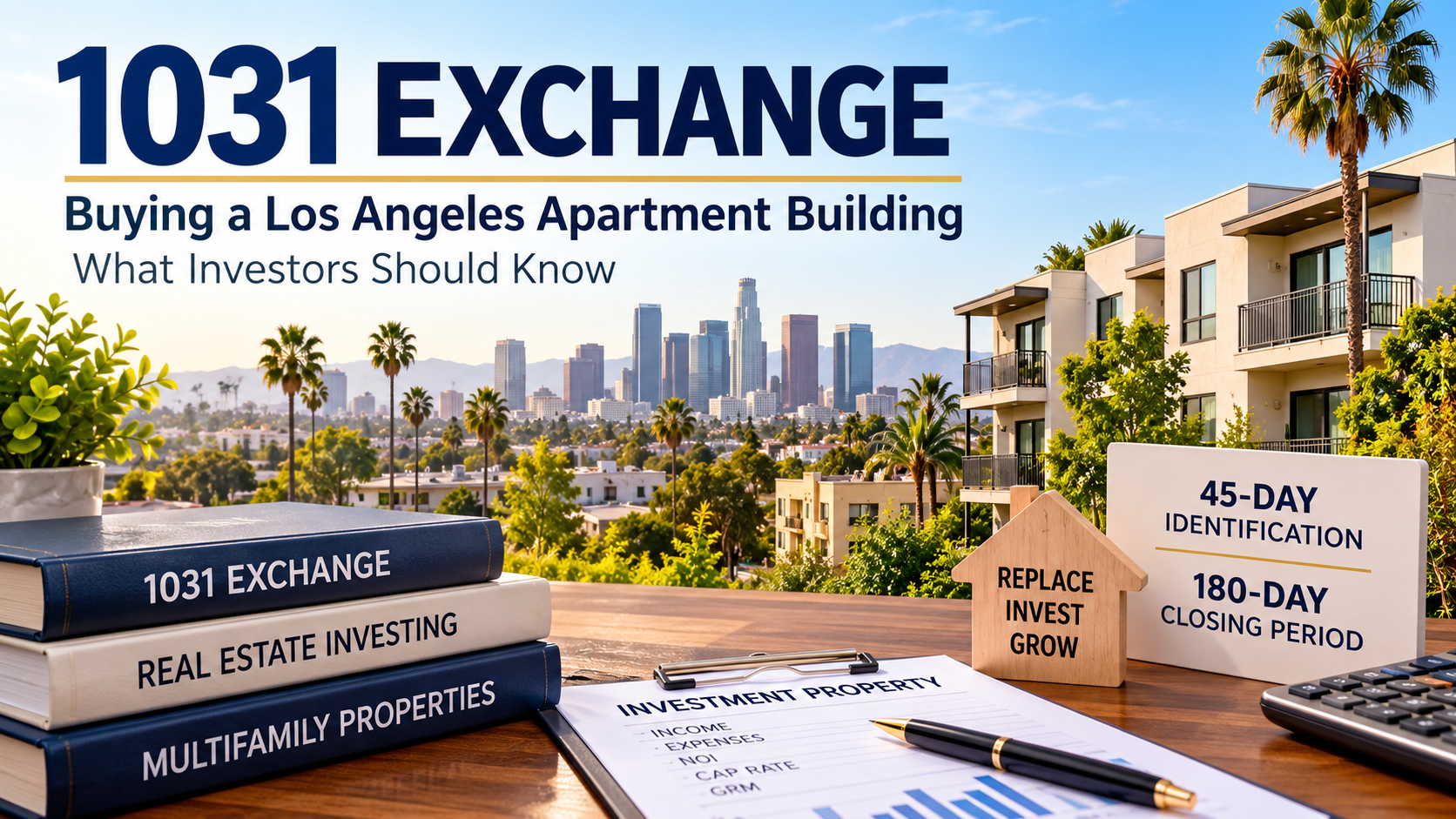
Buying a Los Angeles Apartment Building With a 1031 Exchange: What Investors Should Know

1031 Exchange Guide – Buying a Los Angeles Apartment Building as an Investment PropertyBuying an apartment building in Los Angeles as part of a 1031 exchange can be an attractive strategy for real estate investors who want to continue investing in income-producing property while potentially deferring recognition of certain taxable gains.
But a 1031 exchange is not simply a matter of selling one property and buying another. There are important requirements, strict deadlines and investment considerations that should be understood before choosing a replacement property.

As a Los Angeles real estate professional with more than 20 years of experience, including extensive experience with multifamily and income-producing properties, I help investors identify and evaluate apartment-building opportunities based on both the property and its investment fundamentals.

Planning a 1031 Exchange Into a Los Angeles Apartment Building?

Discuss potential replacement-property criteria and investment opportunities. Consult your qualified intermediary and tax advisor about exchange requirements.

DISCUSS YOUR REPLACEMENT PROPERTY SEARCH

What Is a 1031 Exchange?

Section 1031 of the Internal Revenue Code allows qualifying investors to exchange real property held for investment or business purposes for other qualifying real property and potentially defer recognition of gain.

For real estate investors, this may provide an opportunity to move from one investment property into another while keeping more capital invested in real estate.

A 1031 exchange does not eliminate taxes automatically, and every investor's circumstances are different. Investors should work with qualified tax and exchange professionals to determine whether a transaction qualifies.

Can an Apartment Building Be a 1031 Exchange Replacement Property?

An apartment building held for investment can potentially qualify as replacement property in a 1031 exchange.

One important concept is that “like-kind” does not necessarily mean exchanging an identical type of building for another identical building. Qualifying U.S. investment real estate can generally be exchanged for other qualifying U.S. investment real estate, subject to the applicable rules.

For example, an investor selling qualifying investment real estate may potentially acquire a Los Angeles apartment building as the replacement property.

Understand the 45-Day Identification Period

Timing is one of the most important parts of a deferred 1031 exchange.

Generally, an investor must identify potential replacement property within 45 days after transferring the relinquished property.

That can make the search for a replacement apartment building very different from an ordinary real estate purchase. Investors may need to evaluate available properties quickly while still performing careful financial analysis.

Starting the property search early can therefore be extremely important.

Understand the 180-Day Exchange Period

Generally, the replacement property must be received within 180 days after transferring the relinquished property, or by the due date of the investor's tax return, including extensions, whichever occurs first.

Because the deadlines can be strict, investors should coordinate early with their qualified intermediary, tax professional, lender and real estate professional.

The Role of a Qualified Intermediary

In a typical deferred 1031 exchange, investors often use a qualified intermediary to facilitate the exchange.

One critical issue is avoiding actual or constructive receipt of the proceeds from the relinquished property. A properly structured exchange using a qualified intermediary can help facilitate the transaction while the investor acquires the replacement property.

The qualified intermediary should generally be selected and the exchange structure discussed before the relinquished property closes.

Don't Let the 1031 Deadline Replace Good Investment Analysis

The pressure of a 1031 exchange deadline can make investors feel they must purchase something quickly.

But meeting an exchange deadline does not automatically make a property a good investment.

When evaluating a Los Angeles apartment building, investors should still examine important factors such as:

  • Current rental income
  • Operating expenses
  • Net Operating Income (NOI)
  • Cap rate
  • Gross Rent Multiplier (GRM)
  • Unit mix
  • Current and potential rents
  • Property condition
  • Location
  • Comparable sales
  • Financing
  • Potential capital improvements
  • Overall investment objectives

A replacement property should make sense as an investment—not simply satisfy a deadline.

Evaluate the Apartment Building's NOI

Net Operating Income is one of the most important numbers when evaluating an apartment building.

NOI = Property Income - Operating Expenses

Review the property's actual income and operating expenses rather than relying only on projected numbers.

Understanding the NOI can help investors compare different multifamily opportunities and evaluate the property's income-producing performance.

Consider Cap Rate and GRM

Cap rate and Gross Rent Multiplier are two commonly used tools for evaluating multifamily properties.

Cap Rate = NOI ÷ Property Value

Cap rate can help investors compare a property's income to its price.

GRM compares a property's price with its gross rental income. It is a simpler metric and does not account for operating expenses, so it should generally be considered alongside NOI, cap rate and other financial information.

Perform Careful Due Diligence

The 1031 exchange timeline should not eliminate proper due diligence.

Depending on the property and transaction, an investor may want to review items such as leases, rent rolls, operating statements, expenses, building condition, inspections, insurance, financing, title matters and other relevant property information.

The goal is not simply to complete an exchange. The goal is to acquire an investment property that fits the investor's objectives.

Start Looking for Replacement Properties Early

Investors who know they may be completing a 1031 exchange should consider discussing their property criteria before the relinquished property closes.

Knowing your preferred location, price range, number of units, desired return, financing strategy and investment goals can make the replacement-property search more focused once the exchange timeline begins.

Looking for a Los Angeles Apartment Building for a 1031 Exchange?

If you're considering purchasing a Los Angeles apartment building or multifamily property as part of a 1031 exchange, I can help you identify available opportunities and evaluate properties based on factors such as rental income, expenses, NOI, cap rate, GRM, location, comparable sales and investment potential.

Contact me to discuss the type of Los Angeles multifamily investment property you're looking for and your investment goals.

Important: This information is provided for general educational purposes only and is not tax, legal or financial advice. Section 1031 transactions can involve complex requirements and individual circumstances. Investors should consult a qualified tax professional, attorney and qualified intermediary regarding their specific exchange.

Oct. 6, 2026

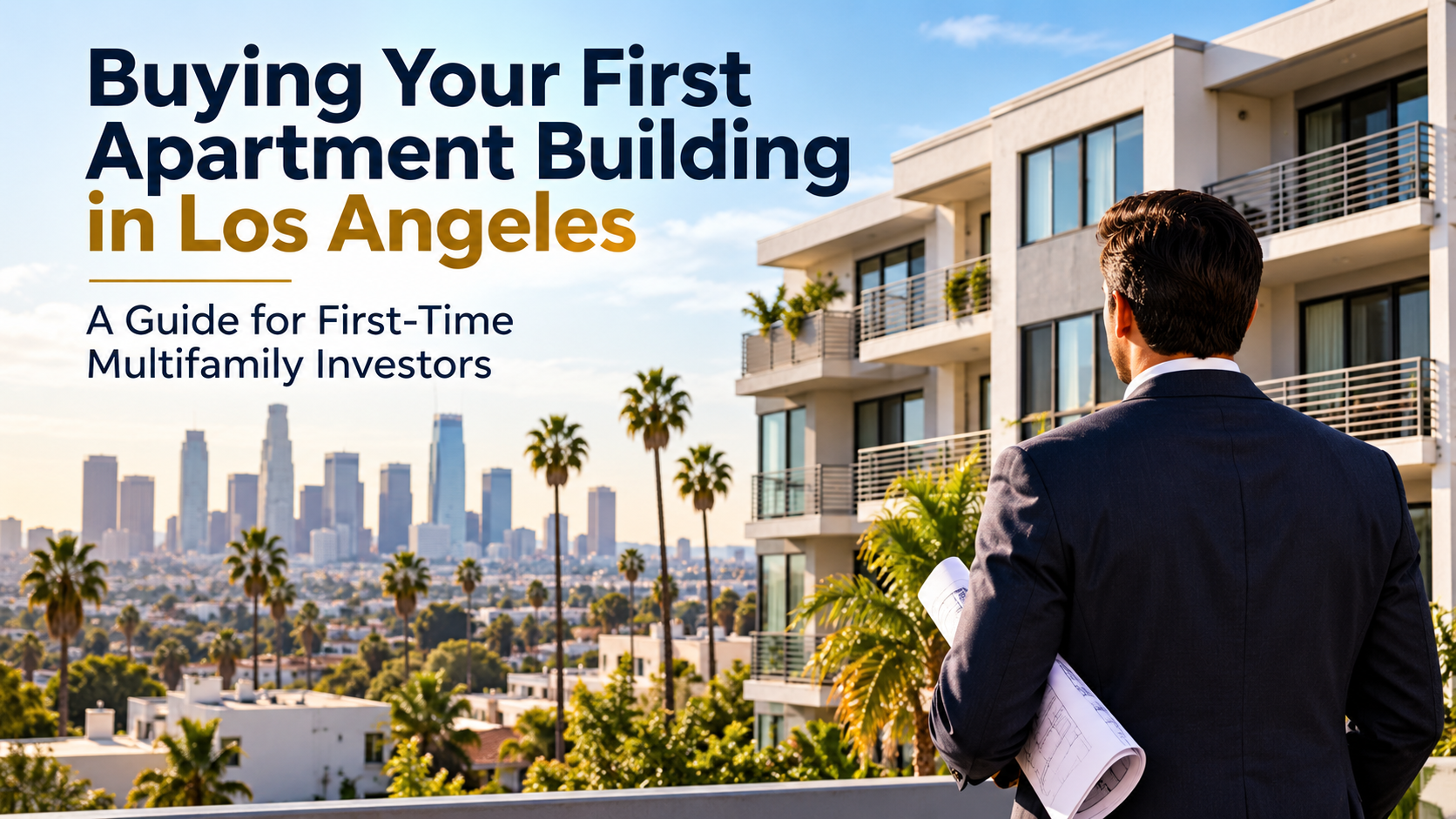
Buying Your First Apartment Building in Los Angeles: A Guide for First-Time Multifamily Investors

Buying your first apartment building in Los Angeles – multifamily investor guideBuying your first apartment building in Los Angeles starts with three questions: what do the verified rents and expenses show, what work does the building need, and does the purchase fit your financing and investment goals? Before purchasing an apartment building in Los Angeles, it is important to understand not only the property itself, but also its income, expenses, financing, location and investment potential.

As a Los Angeles real estate professional with more than 20 years of experience, including extensive experience with multifamily and income-producing properties, I help investors evaluate opportunities beyond simply looking at the asking price.

Ready to Explore Your First Apartment Building?

Discuss your investment goals, property criteria, and the numbers that matter before you buy.

REQUEST YOUR MULTIFAMILY BUYER CONSULTATION

Start With Your Investment Goals

Before searching for an apartment building, determine what you want the investment to accomplish.

Are you primarily looking for monthly cash flow? Long-term appreciation? A property with value-add potential? Are you planning to hold the property for many years, or eventually exchange it for another investment property?

Your goals can influence the type of apartment building, location, unit mix and financial performance that may be appropriate for you.

Understand the Property's Income and Expenses

One of the biggest differences between purchasing a home and purchasing an apartment building is how the property is evaluated financially.

Review the property's current rents, potential market rents, vacancy, operating expenses and other sources of income. Investors should also look carefully at expenses such as property taxes, insurance, utilities, repairs, maintenance and management.

A building with impressive gross rental income may not necessarily be a strong investment if its operating expenses are unusually high.

Learn the Importance of NOI

Net Operating Income, commonly called NOI, is one of the most important numbers when evaluating an apartment building.

In simplified terms:

NOI = Property Income - Operating Expenses

NOI helps investors understand how much income a property generates from its operations before items such as mortgage payments and income taxes.

When comparing multifamily properties, looking beyond the purchase price and understanding the NOI can provide a much clearer picture of how the property is performing.

Understand Cap Rate

The capitalization rate, or cap rate, is another commonly used measurement in multifamily real estate.

In simplified terms:

Cap Rate = NOI ÷ Property Value

For example, two apartment buildings with similar prices may represent very different investment opportunities depending on their income, expenses, condition and location.

A higher cap rate does not automatically mean a property is a better investment. Risk, location, condition, tenant profile, future expenses and potential appreciation should also be considered.

Don't Ignore GRM

Gross Rent Multiplier, commonly called GRM, provides another way to compare income properties.

GRM looks at the relationship between a property's price and its gross rental income. It can be useful as a quick comparison tool, but it does not account for operating expenses.

For that reason, investors should generally evaluate GRM together with NOI, cap rate and the property's overall financial picture rather than relying on one number alone.

Look Beyond Today's Rents

Current income is important, but investors should also consider the property's future potential.

Questions may include:

  • Are rents significantly below current market levels?
  • Are there opportunities to improve units or common areas?
  • Are there unused spaces or other potential sources of income?
  • What major repairs or capital improvements may be needed?
  • How does the unit mix compare with renter demand in the area?

A property with room for improvement may offer opportunity, but investors should carefully evaluate the costs, risks and applicable laws before assuming future income increases.

Location Still Matters

Apartment buildings are income-producing properties, but location remains extremely important.

Consider access to employment centers, transportation, shopping, schools and neighborhood amenities, along with rental demand and competing apartment inventory.

Within Los Angeles, investment performance can vary considerably from one neighborhood to another. Understanding the local market can be just as important as understanding the property's financial statements.

Perform Careful Due Diligence

Before purchasing an apartment building, investors should conduct appropriate due diligence.

Depending on the property and transaction, this may include reviewing leases, rent rolls, income and expense statements, inspections, title information, zoning and permitted use, insurance considerations and other property records.

Qualified professionals such as lenders, inspectors, attorneys, tax professionals and other specialists may also be appropriate depending on the transaction.

Apartment Building Due-Diligence Checklist

  • Verify the income. Compare the rent roll with leases and available operating records; distinguish current collections from projected rents.
  • Review expenses and upcoming work. Examine recurring costs, maintenance history, inspection findings, and major repairs with the appropriate professionals.
  • Check the property records. Review title, permitted use, unit count, permits, and available building records rather than assuming the listing description resolves every question.
  • Check the applicable rental rules. Confirm the property's jurisdiction and obtain professional guidance before relying on rent increases or vacancy assumptions.
  • Confirm financing and deadlines. Discuss lender requirements and document requests early, and keep inspection and contingency dates organized.

For properties within the City of Los Angeles, the Los Angeles Housing Department's RSO property-search guidance is a starting point for checking rent-stabilization coverage. Review the specific units and circumstances with qualified professionals; a property lookup does not replace transaction due diligence.

Financing an Apartment Building

Financing an apartment building may differ from financing a traditional single-family residence.

Loan terms can depend on factors such as the number of units, property income, borrower qualifications, down payment, debt-service requirements and the lender's underwriting standards.

Speaking with a lender experienced in multifamily financing early in the process can help you understand your purchasing power before you begin making offers.

What About a 1031 Exchange?

Some experienced real estate investors purchase apartment buildings as replacement properties in a 1031 exchange.

A properly structured 1031 exchange may allow an eligible investor to defer certain capital gains taxes when exchanging qualifying investment real estate, but strict requirements and deadlines apply.

Because tax situations differ, investors considering a 1031 exchange should consult a qualified tax professional and 1031 exchange intermediary before making decisions.

Common Mistakes First-Time Multifamily Investors Should Avoid

First-time apartment building buyers sometimes focus too heavily on the purchase price or projected rent while overlooking expenses, deferred maintenance or realistic vacancy assumptions.

Other mistakes can include relying entirely on projected income rather than verifying available records, underestimating future repairs, failing to understand local rental regulations, or purchasing without a clear investment strategy.

The objective should not simply be to buy an apartment building. It should be to identify a property that makes sense for your particular investment goals and financial situation.

Search Los Angeles Multifamily Properties for Sale

Browse current Los Angeles multifamily listings. Use the search filters to refine your criteria. Availability and listing information change, and financial details should be verified during your review.

Before your consultation, consider your preferred locations, unit count, budget, financing readiness, and purchase timeline. Share those criteria through the buyer consultation form so we can discuss a focused property search and next steps.

Ready to Explore Los Angeles Apartment Building Opportunities?

Whether you're considering your first multifamily investment or you're an experienced investor looking for your next apartment building, I can help you identify properties and evaluate opportunities throughout Los Angeles.

My approach includes looking beyond the listing price to help you understand factors such as rental income, expenses, NOI, cap rate, GRM, comparable sales, location and potential investment opportunities.

Looking for an apartment building or multifamily investment property in Los Angeles? Contact me to discuss your investment goals and the type of property you're looking for.

See examples of my completed multifamily buyer and seller transactions. For a broader overview, read the Los Angeles real estate investing guide.

Already own an apartment building? Request a confidential apartment building valuation before deciding on your next move.

Sept. 9, 2026

How Long Does It Take to Sell a Home in Tarzana in 2026?

Tarzana California real estate market – how long it takes to sell a home in 2026Selling a home in Tarzana is not just about getting the right price — timing matters too. One of the most common questions I hear from homeowners is, “How long will it take to sell my Tarzana home?”
The answer depends on the property, pricing strategy, condition, location, marketing, and current competition. However, recent local market data gives Tarzana homeowners a useful starting point.

Considering Selling Your Tarzana Home?

Get a complimentary home valuation and discuss pricing, timing, and a strategy suited to your property.

GET MY FREE TARZANA HOME VALUATION

How Long Are Homes Taking to Sell in Tarzana in 2026?

As of August 2026, homes in Tarzana had a median of approximately 53 days on the market, according to Realtor.com. Other market data shows a similar timeframe, although statistics can vary depending on the properties and time period being measured.

That means roughly one and a half to two months on the market can be a useful general benchmark in today's Tarzana market. Some well-positioned homes may sell considerably faster, while others can take longer.

It's also important to remember that days on market is only part of the selling timeline. Preparing the property, photography, marketing, negotiations, inspections, appraisal, and escrow can all affect the total amount of time between deciding to sell and successfully closing the transaction.

What Makes a Tarzana Home Sell Faster?

Several factors can have a major impact on how quickly a home attracts a serious buyer.

Pricing correctly from the beginning is one of the most important. Buyers today have access to extensive market information and can quickly compare your property with competing homes.

Condition and presentation also matter. A clean, well-maintained and properly presented property can make a stronger first impression both online and during showings.

Professional marketing can help expose the property to more qualified buyers. Strong photography, online presentation, appropriate positioning and an effective launch strategy can make a meaningful difference.

Finally, location within Tarzana matters. Homes south of Ventura Boulevard, properties in the hills, gated communities, larger lots, remodeled homes, condos and homes in other parts of Tarzana can attract different buyer pools and should not necessarily be marketed or priced the same way.

Can a Tarzana Home Sell in Less Than 30 Days?

Yes, it can.

A desirable Tarzana home that is priced appropriately and presented well can receive strong buyer interest quickly. Recent market data shows that some competitive Tarzana properties can move much faster than the overall market average.

However, pricing a home simply to achieve a fast sale is not always the best strategy. The goal should be to balance timing with obtaining the strongest possible price and terms for the seller.

Why Do Some Tarzana Homes Stay on the Market Longer?

When a property remains on the market significantly longer than competing homes, there is usually a reason.

Common factors include an asking price that buyers perceive as too high, property condition, limited showing availability, weaker marketing, unusual property characteristics, or simply greater competition from similar homes.

The longer a property sits without sufficient activity, the more important it becomes to evaluate the market's response and determine whether the selling strategy should be adjusted.

Should I Sell My Tarzana Home Now or Wait?

Timing the market perfectly is extremely difficult. Your personal circumstances, financial goals, property condition and plans after the sale can be just as important as market statistics.

If you're considering selling, understanding what your particular Tarzana home could realistically sell for today can make the decision much easier.

Rather than relying only on an automated estimate, I look at recent comparable sales, active competition, location, condition, improvements and the characteristics that make your property different.

Find Out What Your Tarzana Home Could Sell For

I've worked in Los Angeles real estate for more than 20 years and understand that selling a home is a major financial decision.

If you're considering selling your Tarzana home — whether soon or simply exploring your options — I can prepare a complimentary, no-obligation home value analysis and discuss a realistic selling strategy and timeline for your property.


Request Your Complimentary Tarzana Home Valuation

Sept. 8, 2026

Should I Sell My Los Angeles Apartment Building in 2026 or Wait Until 2027?

Los Angeles apartment building – sell in 2026 or wait until 2027Owning an apartment building in Los Angeles can be a valuable long-term investment, but there may come a time when you begin asking an important question: Should I sell my Los Angeles apartment building now, or would I be better off waiting until 2027?

There is no single answer that applies to every property owner. The right decision depends on your building's current value, rental income, operating expenses, condition, financing, tax considerations, and your personal investment goals.

Before deciding whether to sell or hold, it helps to understand the factors that can influence both the value of your apartment building and the strength of your position as a seller.

Should You Sell Your Los Angeles Apartment Building?

Get a confidential property analysis that considers rents, expenses, comparable sales, and today's investment market.

REQUEST MY CONFIDENTIAL APARTMENT BUILDING ANALYSIS

What Determines the Value of a Los Angeles Apartment Building?

Apartment buildings are valued differently from typical single-family homes. While comparable sales are important, experienced multifamily buyers also pay close attention to the property's income and operating performance.

Some of the most important factors include:

  • Current rental income and rent roll
  • Operating expenses
  • Net operating income (NOI)
  • Cap rate
  • Gross rent multiplier (GRM)
  • Number of units and unit mix
  • Property condition and deferred maintenance
  • Parking and other property amenities
  • Location and neighborhood
  • Recent sales of comparable apartment buildings
  • Potential for future income growth

Two apartment buildings with a similar number of units can have significantly different values because of differences in income, expenses, condition, location, and future potential.

Reasons an Owner May Consider Selling in 2026

For some Los Angeles apartment-building owners, selling in 2026 may make sense. An owner may want to take equity out of the property, simplify an investment portfolio, retire from active property ownership, exchange into another investment, or simply move on from the responsibilities of managing an apartment building.

Other owners may discover that their property has appreciated substantially over the years and want to understand what today's market might offer before deciding whether to continue holding.

The important point is that you don't necessarily have to decide to sell before finding out what your building may be worth.

When Might Waiting Until 2027 Make Sense?

Waiting may be appropriate when the property continues to meet your investment objectives and you are comfortable with its income, expenses, financing, and management responsibilities.

An owner may also choose to hold if there are opportunities to improve the property's financial performance or if selling today would not accomplish the owner's longer-term financial or investment goals.

However, waiting solely because you assume the property will automatically be worth more next year can be risky. Real estate values can be affected by interest rates, financing conditions, investor demand, operating costs, rents, insurance expenses, regulations, and the overall economy.

Should I Make Improvements Before Selling My Apartment Building?

Not every apartment building needs extensive improvements before going on the market. In many cases, investors are more interested in the property's income, location, unit mix, condition, and future potential than cosmetic upgrades.

Before spending substantial money on improvements, it can be helpful to determine which repairs or changes are likely to improve marketability or value and which may provide little return when the property is sold.

How Can I Know What My Apartment Building Is Worth Before I Decide?

This is often the best place to start.

A property analysis can help you understand how your building compares with recent multifamily sales and how factors such as income, expenses, NOI, cap rate, GRM, unit mix, condition, and location may affect its potential market value.

If you own a multifamily property in Los Angeles, you can request a confidential apartment building property analysis here. There is no obligation to sell.

Selling an Apartment Building Is Different From Selling a House

Marketing an income-producing property requires a different approach from selling a typical residence. Potential buyers may include individual investors, experienced multifamily owners, partnerships, and other real estate investors who evaluate the property based heavily on its financial performance and investment potential.

Preparing accurate property information and positioning the building properly can make an important difference in how investors evaluate the opportunity.

How to Sell an Apartment Building in Los Angeles

Selling an apartment building in Los Angeles typically starts with understanding the property's current market value and preparing the financial information that serious multifamily buyers will want to review.

Before bringing the property to market, an owner should consider:

  • Reviewing the current rent roll and rental income
  • Organizing operating expenses and calculating net operating income (NOI)
  • Evaluating the property's cap rate and gross rent multiplier (GRM)
  • Reviewing recent sales of comparable Los Angeles apartment buildings
  • Identifying deferred maintenance or improvements that may affect value
  • Developing a pricing and marketing strategy designed to reach qualified multifamily investors

The goal is not simply to put the building on the market. It is to present the property clearly, support its value with accurate financial information, and position it effectively for the investors most likely to purchase it.

How I Market Los Angeles Apartment Buildings to Qualified Investors

Selling an apartment building requires a different marketing strategy than selling a single-family home. Investors focus on rental income, operating expenses, net operating income (NOI), cap rates, gross rent multipliers (GRM), and the property's potential for future growth.

With more than 20 years of real estate experience and extensive knowledge of multifamily and income-producing properties, I offer a targeted approach to marketing Los Angeles apartment buildings.

My marketing strategy includes:

  • Professional Offering Memorandum (OM): Presenting the property's financial information, rental income, expenses, investment highlights, and potential opportunities in an organized marketing package.

  • MLS and LoopNet Exposure: Marketing properties through appropriate residential and commercial real estate platforms to reach a broader audience of potential investors.

  • Professional Photography, Drone Imagery, and Video: Showcasing the property through compelling visuals when appropriate.

  • Investor-Focused Marketing: Reaching potential buyers and cooperating with agents who specialize in multifamily and investment properties.

  • Pricing and Negotiation Strategy: Evaluating comparable sales, income performance, market conditions, and buyer qualifications to develop an effective pricing and negotiation approach.

My goal is not simply to put your apartment building on the market. It is to present your property professionally, attract qualified investors, and help you make informed decisions throughout the selling process.

Thinking About Selling Your Los Angeles Apartment Building?

If you're considering selling in 2026, waiting until 2027, or simply trying to understand your options, the first step does not have to be putting your property on the market.

It can simply be finding out what your apartment building may be worth and discussing the advantages and disadvantages of selling based on your particular situation.

I'm Shawn Pourebrahim, a Los Angeles real estate professional with more than 20 years of experience, including extensive experience with multifamily and income-producing properties.

Request your confidential Los Angeles apartment building property analysis.

No obligation. Confidential. Los Angeles multifamily real estate.